


Insights
From Tarmac to Terminal: Integrated Communications for Airport Teams
20 April 2026Airports are among the most demanding operational environments in Australia. Teams are spread across airside, terminals and landside facilities, working to tight timeframes under strict safety and security obligations. Ground handling, facilities, security and terminal operations all rely on clear, reliable communication to keep aircraft moving and passengers safe.
Yet communication is often fragmented. High noise levels on the tarmac make instructions difficult to hear. Coverage can vary between indoor terminal spaces and outdoor airside areas. Different teams may rely on separate devices or channels, creating information gaps that slow coordination. When delays or incidents occur, the impact can be felt across flight schedules, customer experience and regulatory compliance.
For airport operators, the challenge is maintaining safe and efficient operations when teams are mobile, environments are noisy and priorities can change minute by minute. Integrated communications provide a practical, proven way to address this complexity.
Why integrated communications matter
Airports operate under constant pressure. Turnaround windows remain tight, passenger volumes fluctuate throughout the day and safety standards leave little margin for error. When communication systems are disconnected, the risk of misheard instructions, duplicated effort and delayed response increases.
An integrated communications approach brings voice, data and operational workflows together so teams can work with greater confidence and consistency. For airport environments, this delivers measurable benefits:
- Improved safety, with clear group calling and dependable coverage in high-risk areas
- Greater operational efficiency, as task updates reach the right teams without duplication
- Better passenger experience, through faster resolution of incidents and smoother handovers between airside and terminal teams
- Stronger compliance support, using standardised processes and, where required, recorded communications to assist reporting and audits
Rather than adding complexity, well-designed systems simplify how information flows across the airport.
MOTOTRBO DMR: Mission-critical voice applications
Digital Mobile Radio, delivered through Motorola Solutions MOTOTRBO systems, forms the foundation of reliable voice communications for many airport operations. DMR is well suited to environments where group calling, clarity and predictable coverage are essential.
For airside and terminal teams, MOTOTRBO delivers clear audio even in noisy conditions, helping ensure instructions are understood first time. Flexible talk groups allow ground handling, facilities, security and maintenance teams to coordinate without cross-channel interference. Purpose-designed infrastructure provides consistent coverage across indoor and outdoor areas, supporting safe movement between zones.
DMR also enables location and data services that give supervisors better visibility of teams and vehicles, supporting more efficient task allocation. Text messaging can be used for short updates where a voice call is unnecessary, providing flexibility without disrupting workflows.
The result is straightforward, dependable communication that supports both daily operations and peak periods without relying on public mobile networks.
MOTOTRBO Ion: Hybrid voice and broadband data in one device
For airport teams that require both mission-critical voice and access to digital workflows, MOTOTRBO Ion offers a practical hybrid solution. Ion combines professional two-way radio capability with broadband data in a single rugged device.
Built on Android, MOTOTRBO Ion supports an open application environment, allowing airport-specific workflows such as task management, incident reporting or asset checks to be accessed alongside push-to-talk voice. Its robust design and environmental protection make it suitable for field use across airside and terminal settings.
By supporting DMR and broadband connectivity, Ion allows staff to stay connected as they move between coverage zones. Ground handling teams can manage tasks while remaining available on group calls. Supervisors can monitor communications and operational data without carrying multiple devices. This reduces hand-offs, simplifies training and improves responsiveness when conditions change.
Sensear Smart Hearing Protection: Clarity in high-noise areas
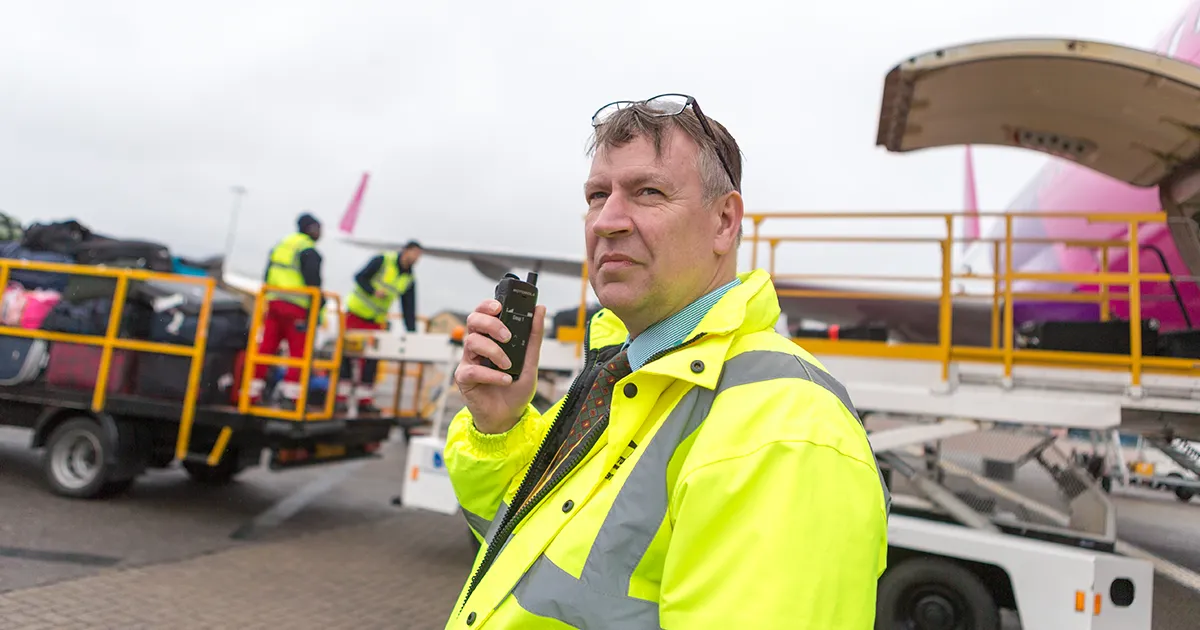
Noise exposure is unavoidable on the tarmac, yet hearing protection must not prevent effective communication. Sensear smart hearing protection addresses this challenge by enhancing speech while reducing harmful background noise.
These devices allow users to maintain situational awareness, helping them detect surrounding sounds and hazards while protecting hearing. Advanced noise management improves speech clarity around aircraft engines, ground power units and conveyor systems.
For baggage handlers, airside maintenance and ramp crews, this supports safer coordination without the need to remove hearing protection, reducing the risk of missed instructions or unsafe behaviour.
Design, integration and support with CSE Crosscom
Technology alone does not deliver operational improvement. Communication systems must be designed around real airport workflows and supported throughout their lifecycle.
CSE Crosscom provides consulting, coverage design, system integration and ongoing support to ensure airport communications solutions remain reliable and fit for purpose. By aligning technology with operational requirements, deployment risk is reduced and systems continue to perform as airport needs evolve.
Integrated communications help airports operate smoothly across busy, distributed environments. With dependable voice, access to operational data and intelligent hearing protection, teams are better equipped to coordinate safely and efficiently.
If you are reviewing airport communications or planning operational improvements, contact CSE Crosscom to discuss a tailored solution aligned to your airport environment.